W@Home simulates wave propagation and graph geometry on
fractally carved substrates — Menger sponges at recursion levels L3/L4,
prime-ladder carves, and spherical carves — and asks which of their measured
properties survive pre-registered scrutiny.
This page is the public ledger of that program. The discipline is the
point: hypotheses and kill bars are written down before the runs,
post-hoc findings are labeled post-hoc and sent back for a registered confirmation
before they may carry weight, and nulls are published with the same prominence as
confirmations. This is the project that went looking for physical constants in
vibration spectra — and published its own falsification when the hit rate came back
below the random null (4/14 constants matched vs a null average of
5.18 at the same tolerance; search-before-registration is dead as a method).
Every number below is taken from the project ledger
(experiments/menger_research/README.md),
whose wave-physics campaign Q8–Q17 was executed between 2026-08-08 and 2026-08-11 on
falsification rules learned the expensive way earlier that year. All wave runs are
deterministic; every run passes a hard causality check (no signal arrives before
graph-distance ticks — zero violations across every experiment on this page).
Standing rule — a constant-claim is admissible only if the
construction is written down with its physical story before looking at constant
values, and it hits multiple constants above the measured null rate. Nothing so far
passes the first clause alone.
What survived — four claims left standing after the sweep
confirmed
1 · Cone geometry is inherited from the carve
Causal-cone volume on the sponge grows at the carve's Hausdorff exponent,
and the wavefront's maximum speed drops position-dependently —
smooth space shows neither effect. Confirmed reflection-free on an open
(absorbing-boundary) domain.
cone slope 2.749 vs dH = log20/log3 = 2.727 (within 1%)
front speed: sponge 1.11 / 0.70 vs solid 1.78 / 1.92 (corner / interior) — 38–60% slower
open-domain slowdown confirmed: ratios 5.91 (corner), 2.57 (interior)
survives container change: 2.685 on a spherical carve (bar 2.727 ± 0.15)
confirmed · hardened
2 · The interior-source penalty
A source launched inside the carve decays far faster than in any smooth
container tested. Removing wall echo does not explain it away — it makes it
stronger. The strongest claim in the ledger.
At 20.9% retained density — far below the cubic site-percolation threshold
(~31%) — the Menger carve keeps the medium one connected component,
while random removal at the same density shatters it to dust.
carve ball: 0 of 56,000 nodes isolated (Q15b P5)
random-matched controls: largest components of 86 and 68 nodes
— 99.85% / 99.88% of retained cells isolated
construction · validated
4 · The spherical taper carve (T6)
A constructed spherical Sierpiński object whose "taper" removal rule holds
effective dimension rising toward 2 while retained area converges to ~55% of the
sphere and the hole boundary diverges linearly — finite bulk, unbounded internal
boundary, on a ball.
generator validated: D = log₂3 = 1.5850 to 2.2e−16 (machine precision)
taper rule: D₆ = 1.9887 and rising; area₆ = 0.5505 · 4π
boundary increments ≈ const ≈ 21 per generation (diverges linearly)
What died — claims, their killers, and the bars they failed
Claim
Killed by
The bar it failed
A vibrating "droplet" on the carve shells itself (pilot-wave quantization)
Q8, buried by Q17
radial histograms broad everywhere (ent_norm 0.90–0.98); carve-scale preference a clean 1/3 null; Q17 fine memory scan max peak_frac 0.0645 vs 0.10 bar; Ladder B rerun freezes (stuck 0.59–0.74), excluded by the pre-registered moving-state bars
"Slower but louder" — the carve holds the signal above an amplitude floor (post-hoc find, Q9)
Q10 (W1)
carve's absolute reached fraction collapsed from 93–100% (L3) to 1.2–1.6% at L4 — largely a small-size artifact; only a relative, position-dependent advantage survives
registered open-domain endpoint: deep−L1 gap +0.044 < 0.1 kill bar — fails as registered; a post-hoc convergence correction (labeled) recovers only ≥ +0.123 with the monotone ordering broken
"Any holes help" — universal baseline carve advantage (+0.12…+0.19 across all primes, Q13a)
Q16
collapses to +0.02…+0.06 on the open domain — predominantly a closed-box return-path effect
Primality is special (prime-grid carves outperform composites)
Q11 (A2)
p7 vs p9 on the same grid, N within 0.32%, density matched: Δα differs by −0.002, far inside the ±0.05 indistinguishability band
Boundary tunnels carry the far-field signal (strong form)
Q11 (B0)
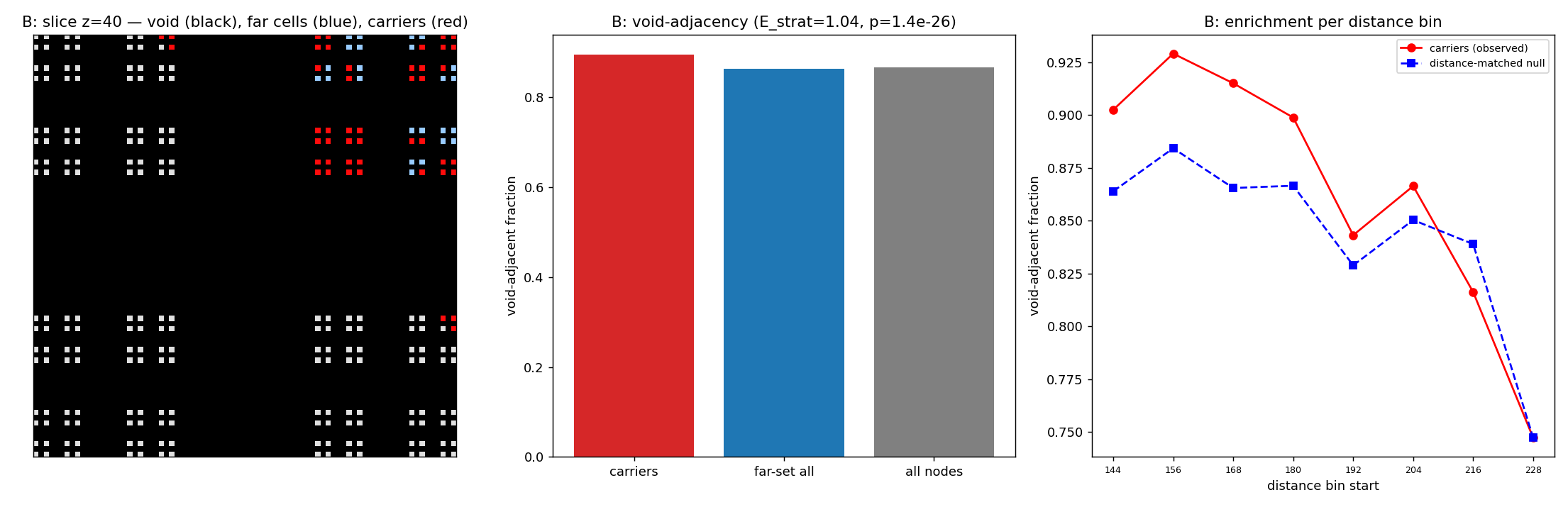
carrier enrichment E = 1.038, inside the ≤ 1.1 kill band — far field is carried by a near-representative cross-section of the bulk
Carve geometry writes the causal-disconnection map (eternal-inflation mapping)
Q15 + Q15b
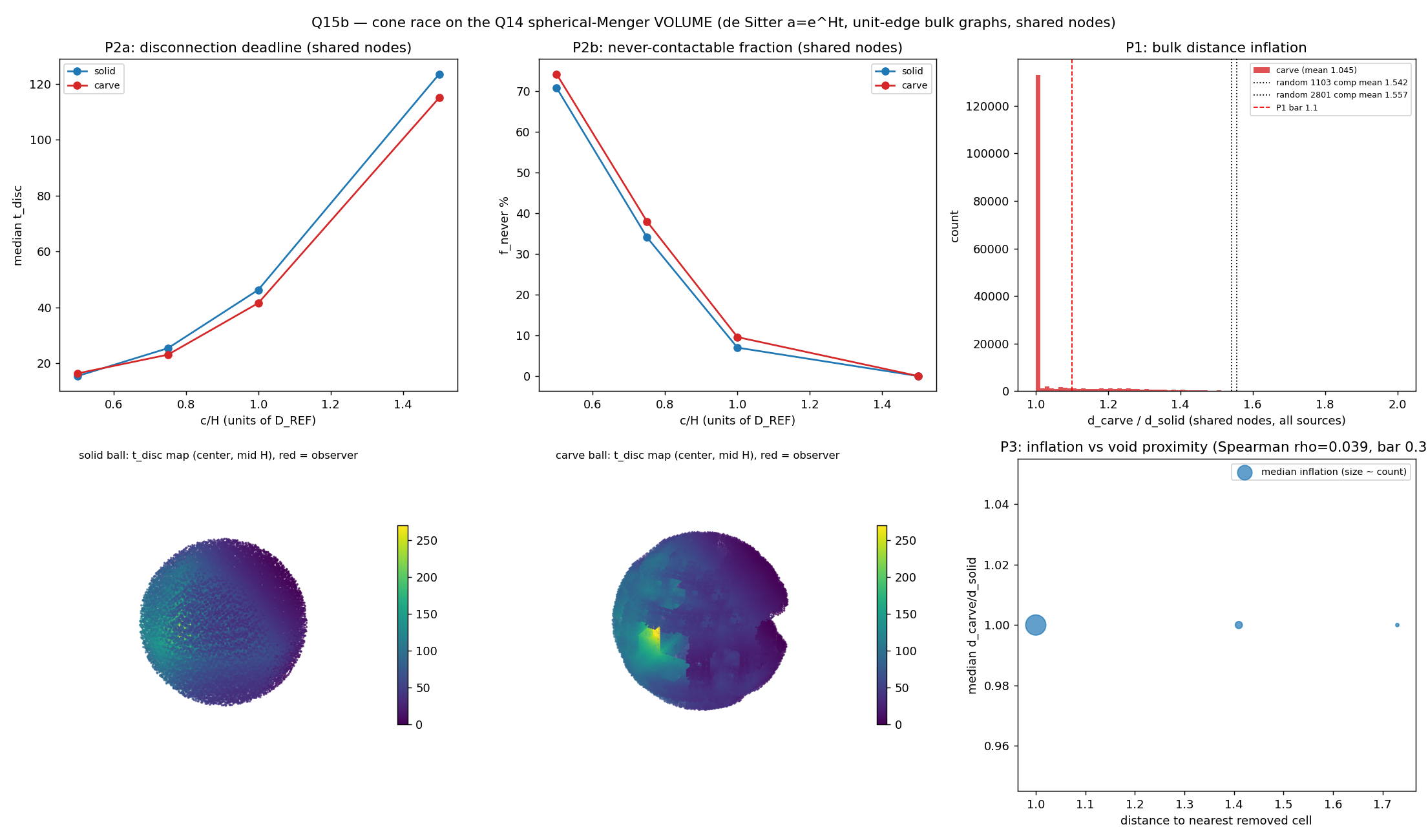
geography ρ = 0.008 (surface) / 0.039 (bulk) vs 0.3 bar; bulk median paired disconnection shift exactly 0 ticks; escape hatch closed at both dimensionalities
Cosmic matter/Λ fractions follow a fractal-removal curve
T3
zero-parameter fit fails by 26× the bar; one-parameter salvage fails both clauses; ratio-slope discriminator: carve predicts 0.3988 where ΛCDM is exactly 3 — the whole constant-k family falsified, 5.2× over the kill bar
"9-grid carve = two 3-grid carves" (hole-census entry)
Q10 (W4)
falsified by construction — kept counts 495,616 vs 160,000 on the 81 grid; different keep sets; correction logged
Physical constants hiding in the spectrum (ratio-hunting)
F1/F2 + constant_scan
94/94 hits, 0 Tier-1, across every substrate; the sponge's 4/14 constant "hits" sit below the random-null average of 5.18 — including a 0.03% weak-mixing-angle hit that random inputs also produce
The full ledger — every entry, in order
Q8falsified2026-08-08
Pilot wave on the carve: can a vibrating excitation shell itself?
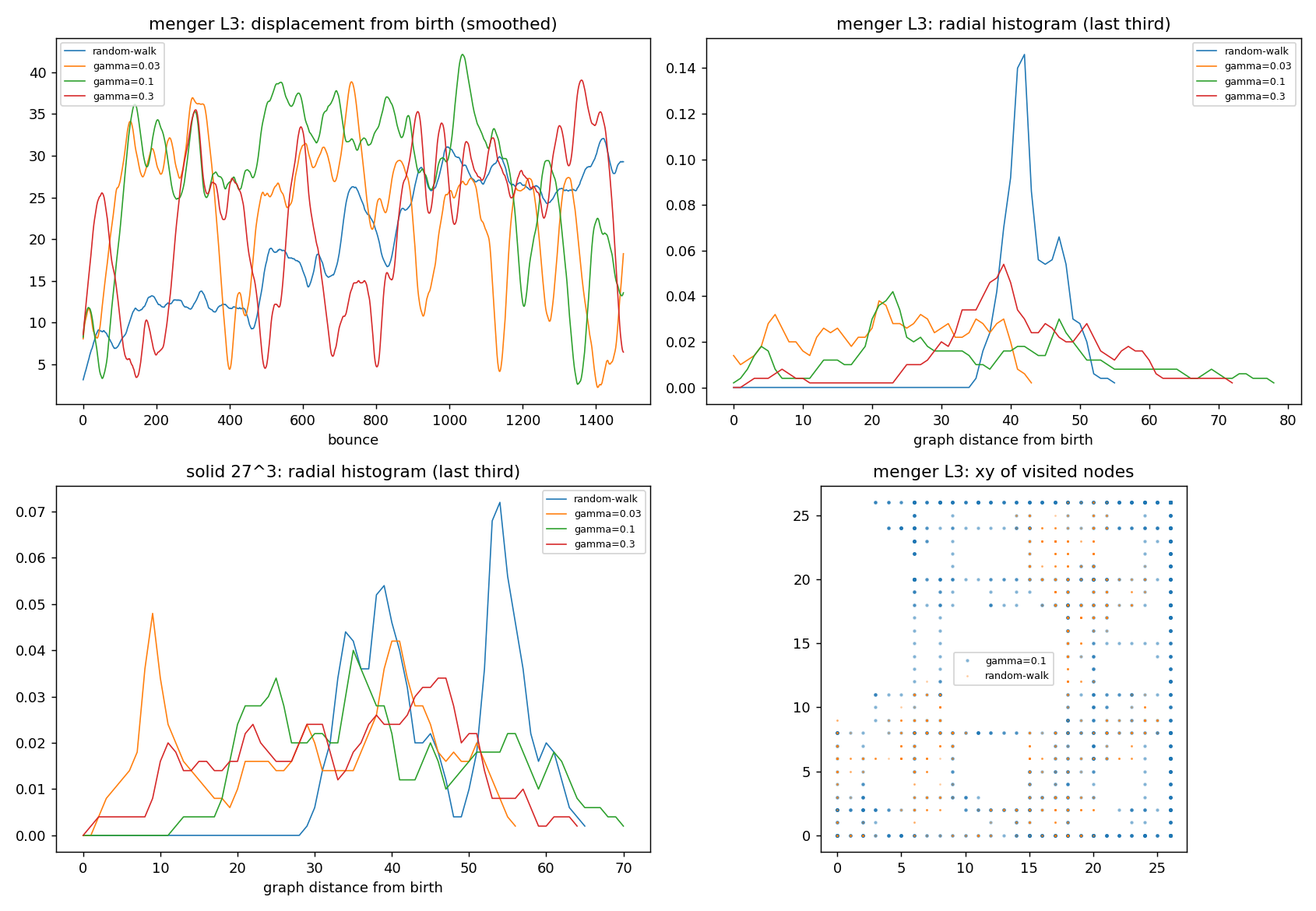
A discrete Couder/Fort analog: a bouncing droplet feels the field left by its own
past splashes. D2 (shell-ness): dead — guided radial histograms are broad
on every substrate at every memory (ent_norm 0.90–0.98, modal bin 3–5%); the sharpest
radial peak in the whole experiment belongs to the sponge's random-walk control.
D3 (carve-scale preference): dead, a clean 1/3 null. D1 confinement was weak
and present on both carve and solid; D4 (memory dependence) was left as the one live
thread, with two declared escape hatches — executed and closed in Q17.
droplet_pilot_wave.png — no radial quantization anywhere; topology's own null confines more than the wave field.
Q9confirmed2026-08-08
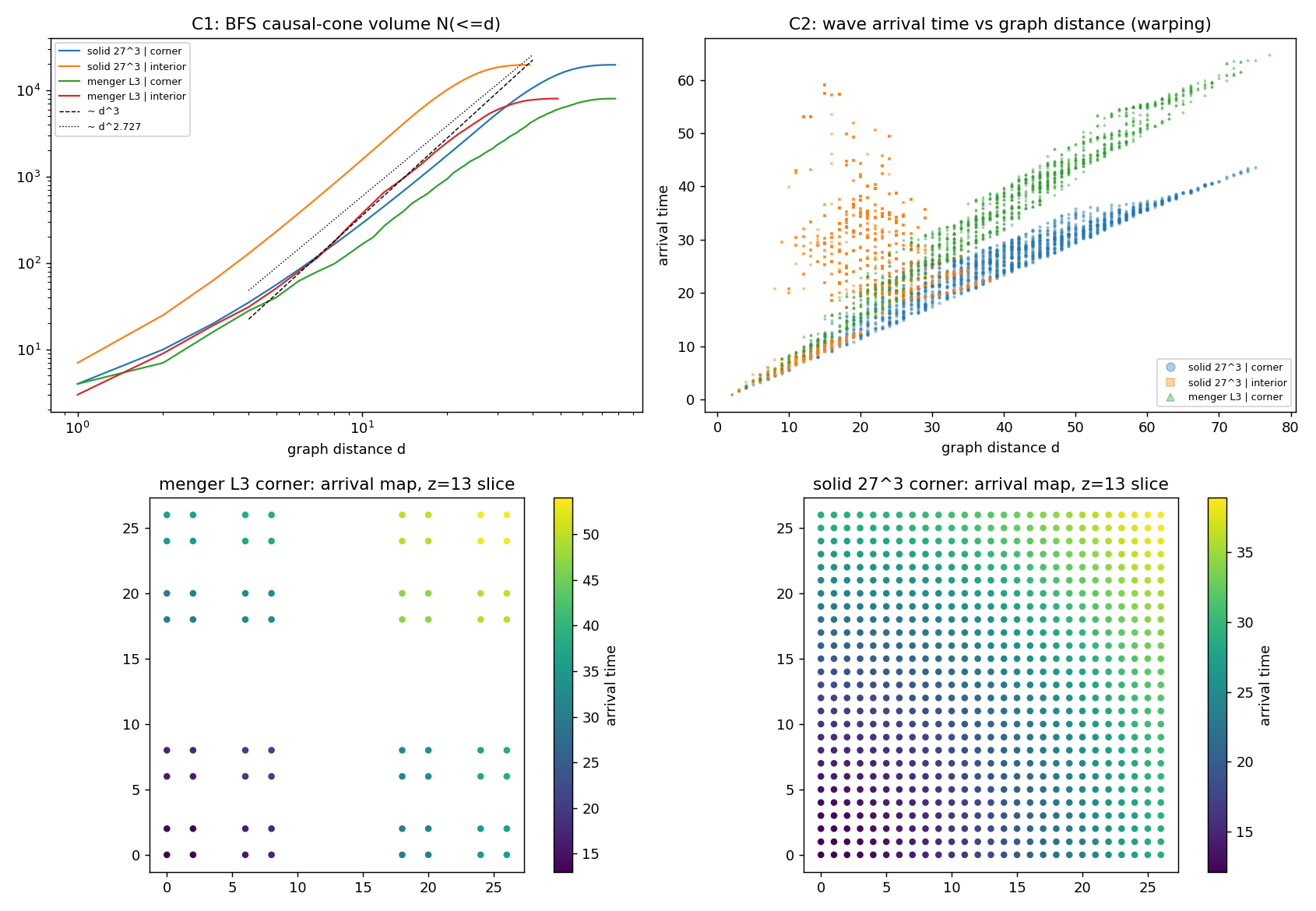
Cone mapping: is the causal cone inherited from the carve?
Two layers: exact BFS cones and wave-arrival cones with a hard causality self-check.
C1 confirmed: sponge interior cone volume grows with slope 2.749 — the
Hausdorff dimension 2.727 within 1% — while the same substrate gives different cones at
different positions (corner 2.255). Front speed confirmed slowed, 38–60%
depending on position. Zero causality violations in all runs. Two honest nulls (no cone
crumpling, no extra corner warping).
Unregistered find, labeled at the time: waveguide concentration
("slower but louder", 100% vs 31% reached at corner, θ = 0.02). It fell out of a
threshold-robustness scan and was sent to Q10 for pre-registered confirmation before
becoming load-bearing — where its absolute form died (see What died).
cone_mapping.png — fractal cone-volume growth and position-dependent front slowdown.
Q10mixed2026-08-08
Waveguide confirmation at L4, and the prime ladder
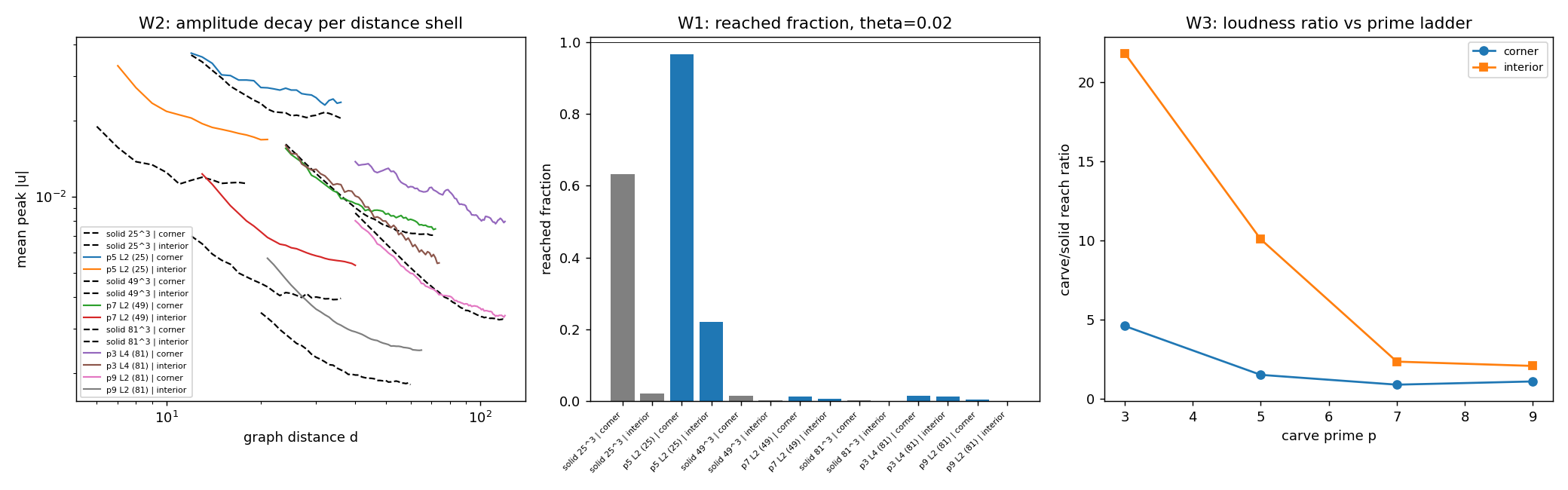
The pre-registered confirmation run for Q9's find, on matched carve/solid pairs up to
the 81-grid. W1 mixed: the carve/solid contrast partially survives scaling
(corner 4.62× passes, interior 21.8× fails the 58× bar) but the absolute effect collapsed —
the loudness was largely a small-size artifact. W2: a threshold-free decay
advantage survives from corner sources (4/4 carves slower: p3 0.536 < 0.896, p5
0.374 < 0.469, p7 0.581 < 0.739, p9 0.750 < 0.896) and reverses from
interiors (0/4). W3: the trend tracks carve density, not primality, and is
size-confounded. W4: the census's "9-carve = two 3-carves" identity falsified
by brute force (kept 495,616 vs 160,000).
waveguide_confirmation.png — the L4 reality check on "slower but louder".
Q11mixed2026-08-09 · pre-registered
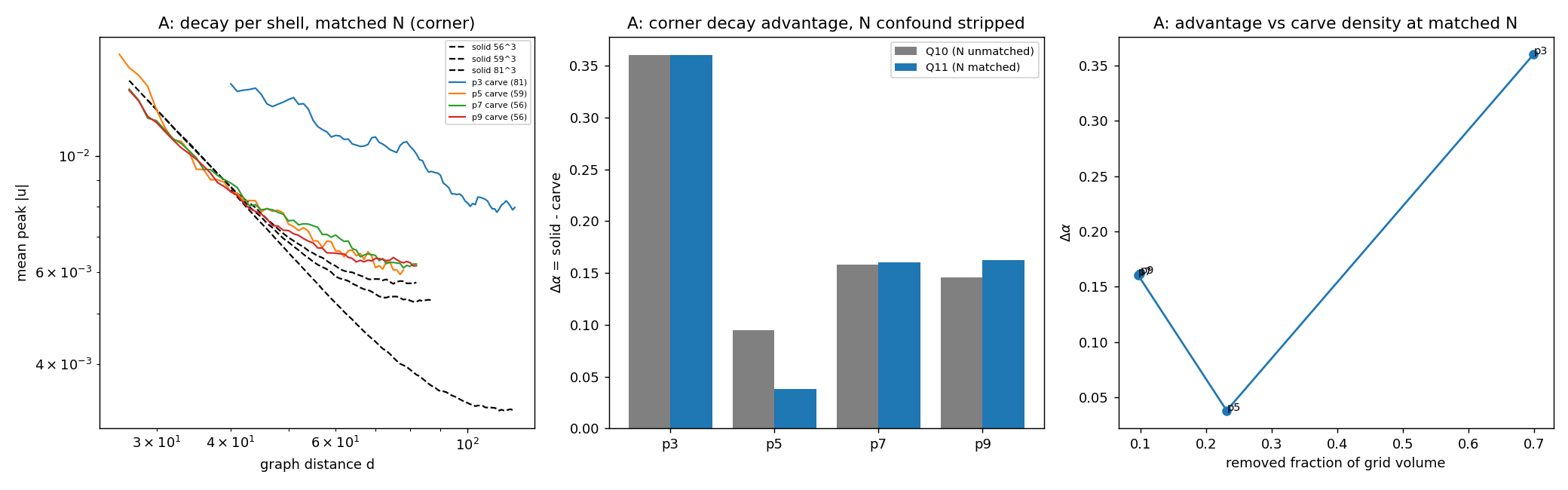
Matched-N ladder + carrier-cell map
Four carves at matched surviving node count (within 1.3%). A0 rejected:
matched N does not erase the ordering (Δα spread 0.322, five times the 0.06 kill bar) — the
advantage is not a size artifact. A2 confirmed: primality is irrelevant
(p7 vs p9 differ by −0.002 at matched everything). But the monotone density law dies too:
p5 sits below p7/p9 despite removing twice their fraction. Part B: the
far-field carrier map gives enrichment E = 1.038 — statistically overwhelming
(p = 1.4e-26) yet inside the ≤ 1.1 kill band, so the strong "tunnels guide" mechanism is
falsified as a far-field story.
Caveat labeled post-hoc: at L4, 86.7% of all kept cells touch void, so
void-adjacency nearly saturates and E's ceiling was ~1.16; the measured lean is ~24% of
maximum headroom.
q11_matchedN.png — p3 stands alone; p7 = p9 kills primality.q11_carrier_map.png — the far field rides the bulk, not the tunnel walls.
Q12confirmed, later weakened2026-08-10 · pre-registered
Depth isolation: does the advantage follow recursion depth?
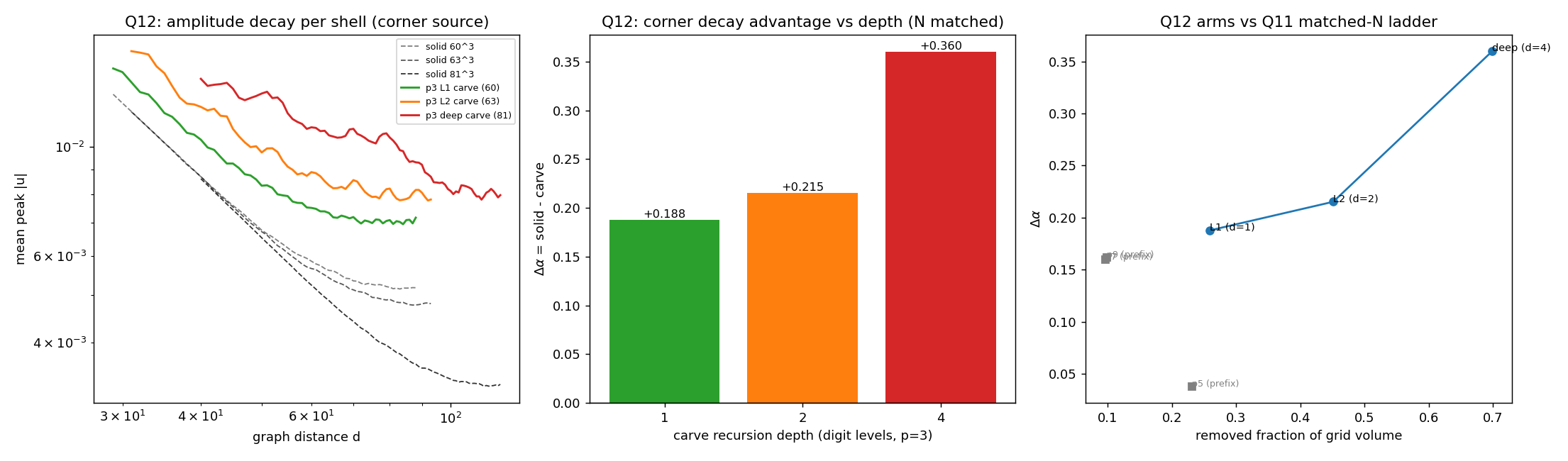
Same prime (p3), only recursion depth varied. D1 fired against both shallow
arms: Δα = +0.188 (L1) → +0.215 (L2) → +0.360 (deep L4), monotone, with
deep-minus-shallow gaps of +0.172 / +0.145 clearing the 0.1 bar. Honest decomposition:
~+0.19 is a generic "carved at all" baseline; ~+0.17 is the depth premium. Only clean
grids used — no truncation edges.
Later history (Q16): on the open domain the registered depth premium
fails its kill bar (+0.044 < 0.1) and the monotone ordering breaks; a labeled post-hoc
convergence correction recovers only a weakened deep-vs-shallow gap (≥ +0.123).
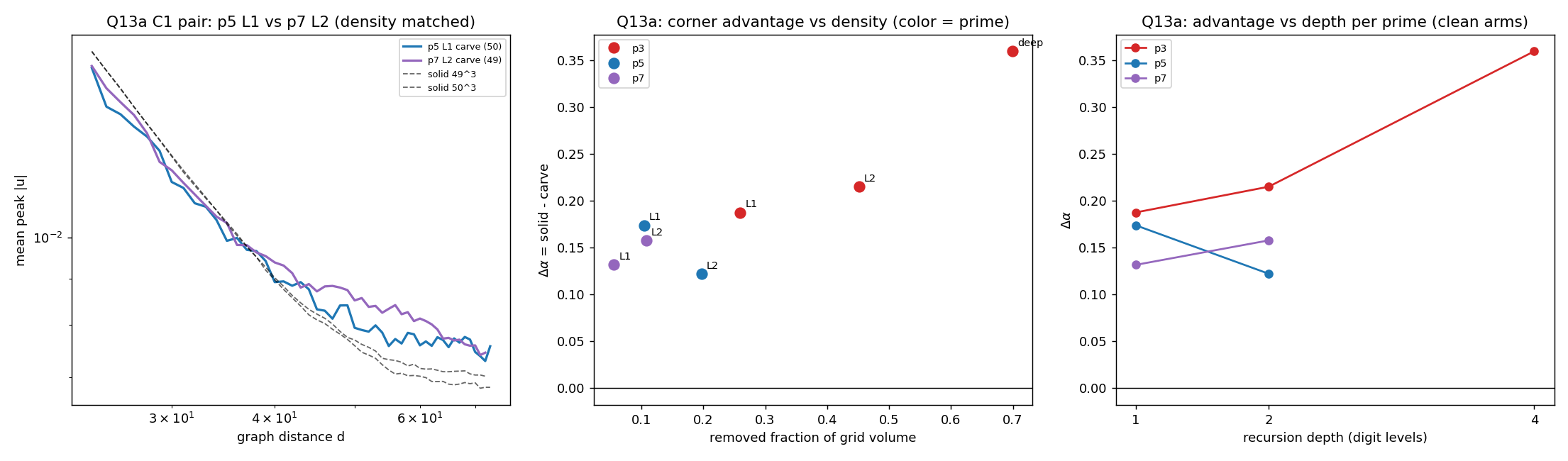
Breaks Q12's depth↔density lock using clean carves on different primes. C1
inconclusive: the one feasible matched-density cross-prime depth pair gives
−0.016, inside the ±0.05 band — no evidence the depth premium transfers off p3 at depths
1–2. C4 leans prime-dependent (deepening p5 nominally hurt: slope −0.052);
C3 is density-inverted. What generalizes across primes is the baseline:
every clean carve beats its own solid, Δα ∈ [+0.122, +0.360] across all 7 arms.
q13a_crossprime.png — the complete set of clean cross-prime arms within budget.
Q13bmechanism found2026-08-10 · pre-registered
Why does the carve hurt interior sources?
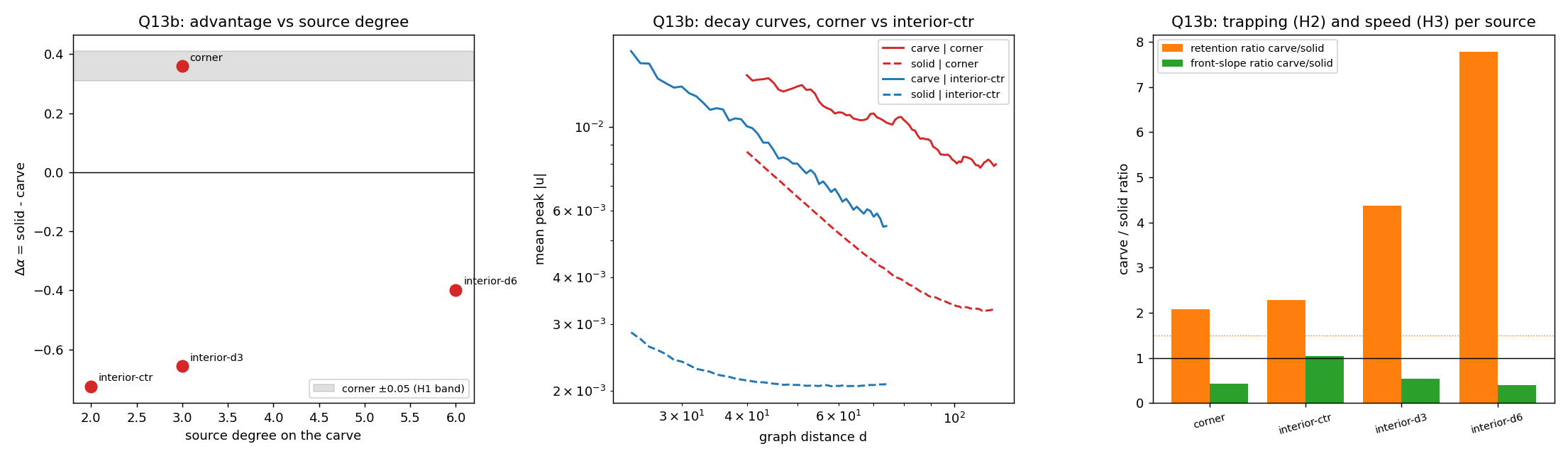
Four source positions on the deep carve vs matched solid. The reversal replicates
strongly (interior Δα = −0.725 vs corner +0.360). H1 killed 10× over the bar:
a degree-3 interior source — same launch geometry as the corner — still lands at −0.657;
the reversal is about position, not degree. H3 fires: interior fronts move
at solid speed (slope ratio 1.041), so the effect is amplitude redistribution, not
propagation failure. Mechanism: ~70% control-side — the closed solid box keeps its
interior far field artificially loud by wall reverberation (α collapses to 0.19–0.21).
Also measured: the carve has zero degree-1 cells — "trapped in dead ends" is dead as
stated; there are no dead ends.
q13b_interior.png — position, not degree; solid-speed fronts; generic void-confinement retention.
Q14mixed2026-08-11 · pre-registered
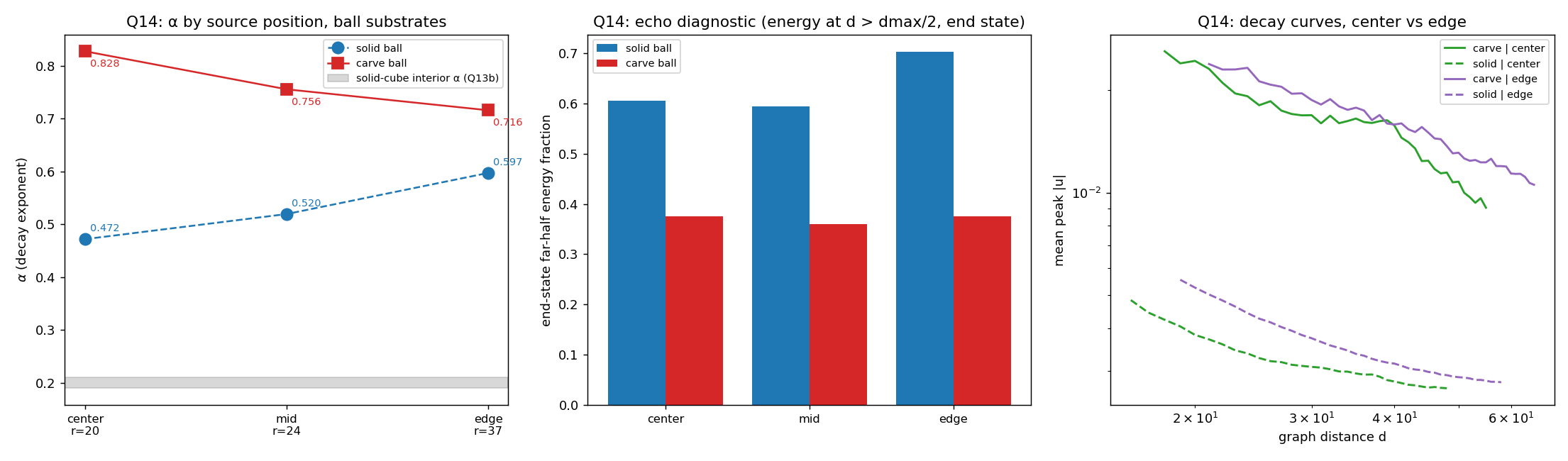
Spherical Menger: do the carve effects survive on a ball?
A ball has neither corners nor flat walls — the two features the cube results leaned
on. P1 confirmed, 2.7× over the bar: the solid ball's center α rises to
0.472 (vs the cube's echo-inflated 0.19–0.21), direct support for the reverberation
account. P2 falsified — the reversal is real: even against the honest
spherical control the carve steepens interior decay by Δα = −0.356. P3
falsified: it is the ball domain, not the carve, that normalizes position
(spreads 0.112 vs 0.125). P4 confirmed: the fractal cone exponent (2.685)
survives the container change — boundary-indifference.
q14_spherical.png — the echo story confirmed, the interior penalty intact, the cone exponent boundary-indifferent.
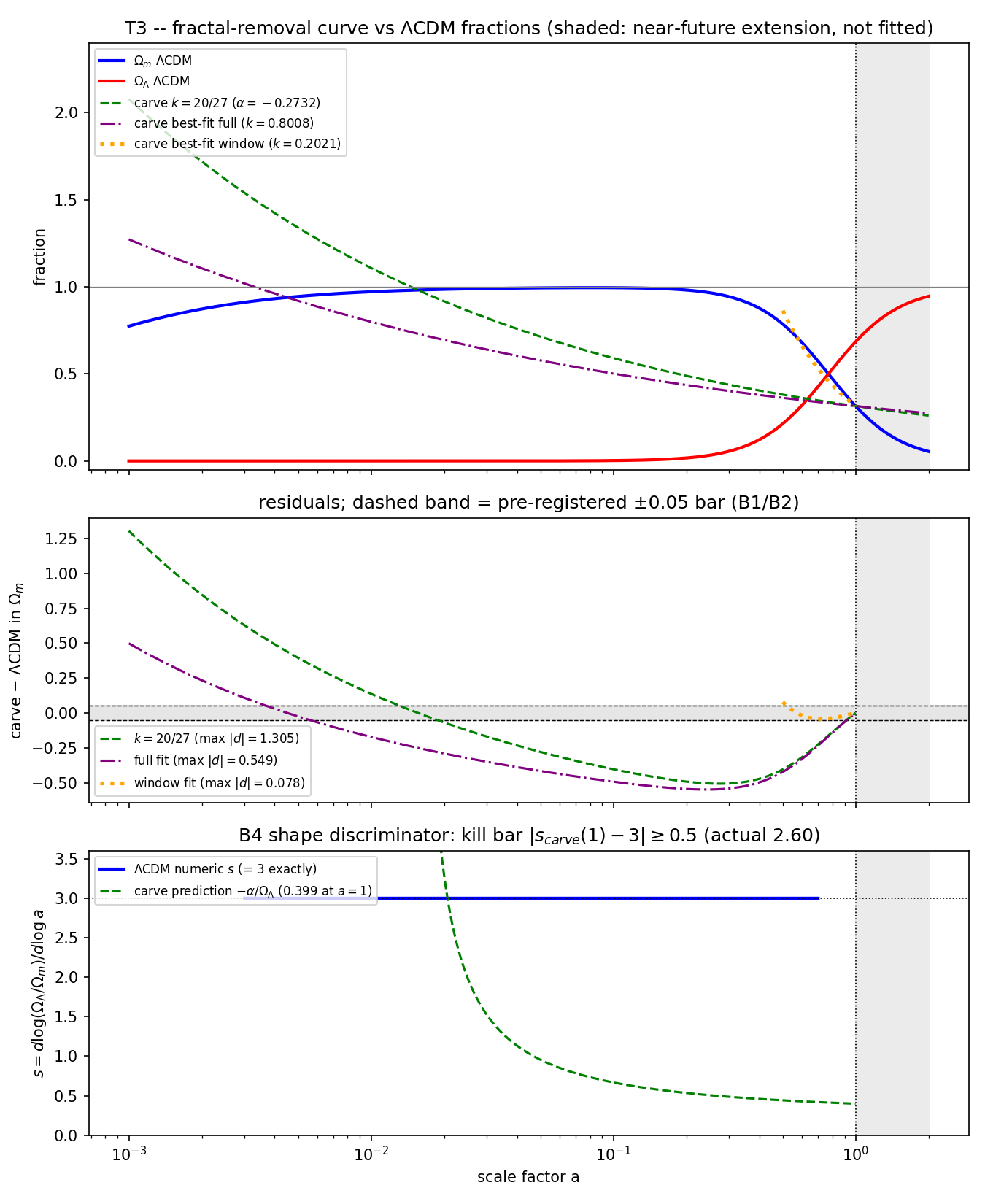
T3falsified2026-08-11 · pre-registered
Carving curve vs cosmic history
Can a constant-retention fractal-removal curve reproduce the ΛCDM matter/Λ fraction
history? No, on every bar. B1 fails by 26× (max deviation 1.3048 vs 0.05);
the pure 20/27 curve is unphysical (Ω_m > 1) for over a decade of early history. B2
fails both clauses (best-fit k = 0.80085 is 3× off the Menger value, residual 0.5493). B3
fails even in the adversarially friendly crossover window. B4 — the real test: ΛCDM's
ratio slope is exactly 3 (numeric check 3.6e-12); any constant-k carve predicts 0.3988
today — the whole family falsified, 5.2× over the kill bar.
t3_carving_curve.png — a late-time tangent, not a cosmic history.
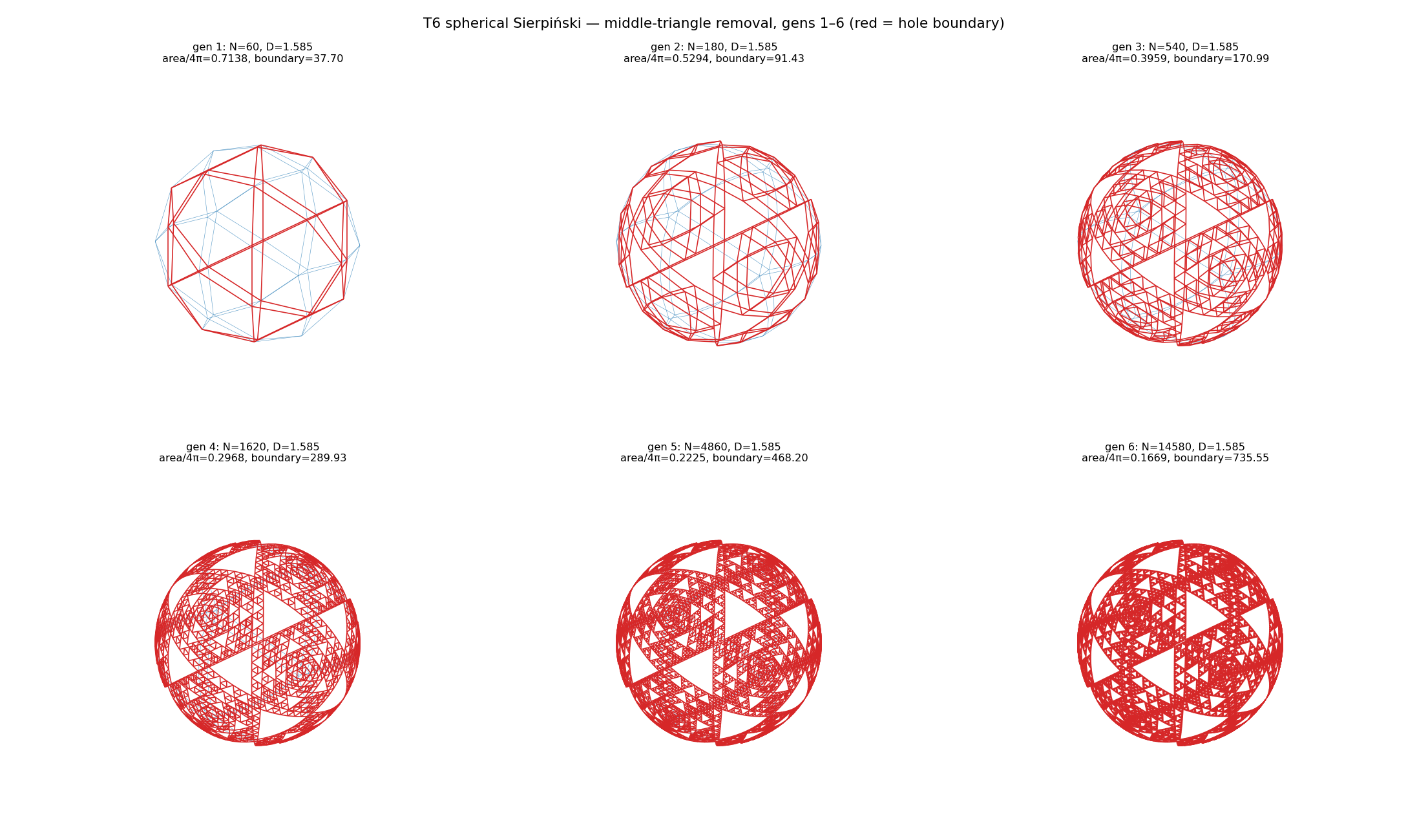
Spherical Sierpiński generator: dimension → 2 with bounded area?
Icosahedral-subdivision sphere with three deterministic removal rules. P0 exact:
the middle rule reproduces the gasket dimension log₂3 = 1.5850 to 2.2e−16 at all six
generations, and the boundary ledger closes to 3.8e−16. P1/P2 pass: hole
boundary diverges with the (3/2)ⁿ law (mean increment ratio 1.4978); hole placement
changes nothing dimensionally. P3 passes all bars: the taper rule climbs
D = 1.5850 → 1.9887 (rising toward 2), holds area at 0.5505·4π and converging, while the
boundary diverges linearly (increments ≈ 21 per generation). P4: "dimension
→ 2 with area → ∞" is impossible on a sphere by geometry; the honest reformulation —
dimension → 2 with diverging boundary and area bounded away from zero — is demonstrated.
t6_spherical.png — finite bulk, unbounded internal boundary, on a ball.
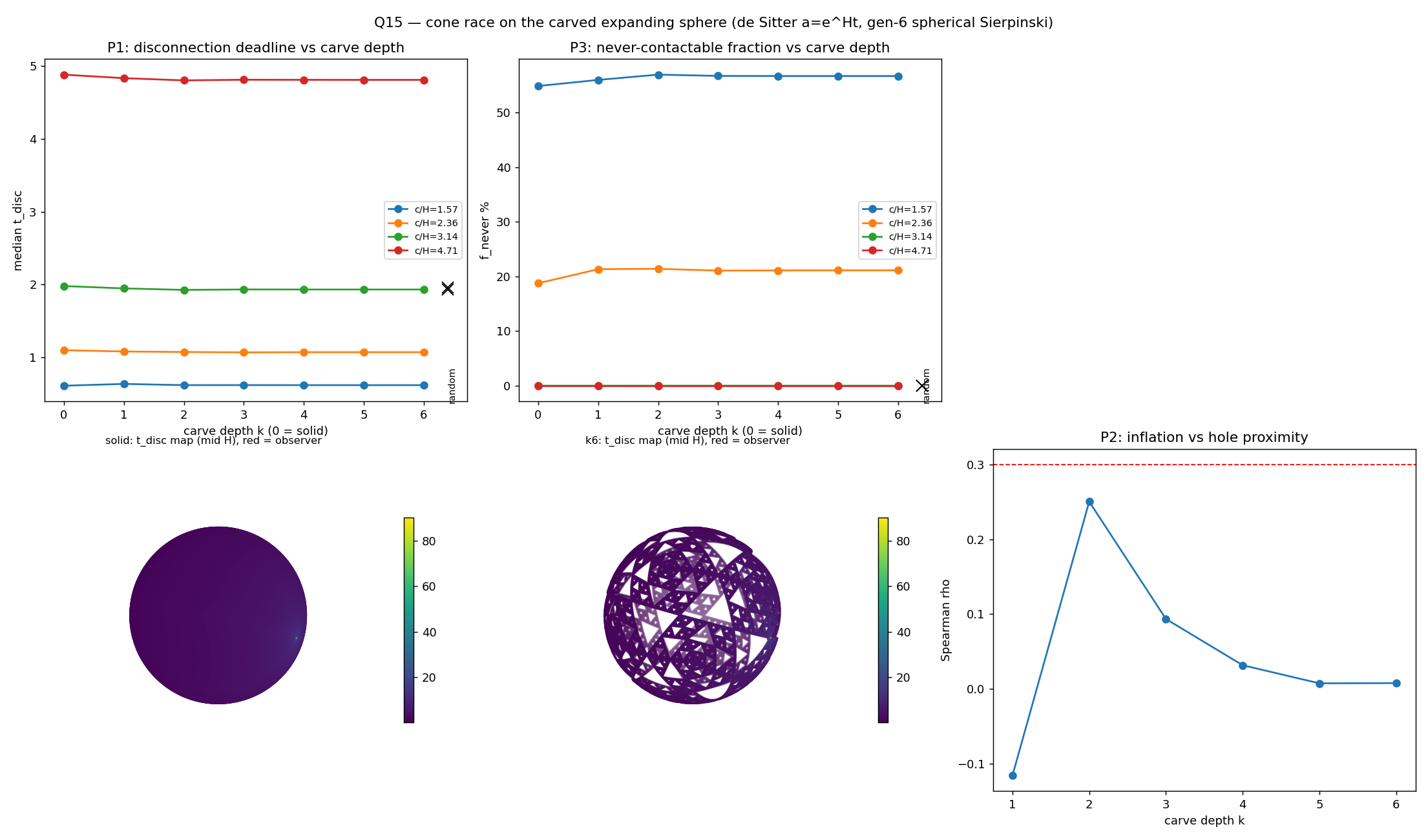
Q15near-total null2026-08-11 · pre-registered
The cone race on a carved expanding sphere (2-D surface)
The eternal-inflation mapping made measurable: sponge material = inflating region,
holes = bubble universes, exact de Sitter expansion. All physics predictions fail. P1:
median disconnection time drops only 1.5–2.5% from k=0 to k=6 and is flat from depth 2.
P2: disconnection geography uncorrelated with hole proximity (Spearman ρ = 0.008 vs the
0.3 bar). P3: never-contactable fraction gap 0–2.4 points vs the 5-point bar. A 2-D
surface carve barely warps metric geometry — detours are cheap. One escape hatch logged
and executed: rerun in the 3-D bulk (Q15b).
q15_expansion_race.png — the disconnection map is written by H and the sphere, not by the carve.
Q15bnull + one real positive2026-08-11 · pre-registered
The same race on the 3-D bulk carve — escape hatch closed
Identical race on the Q14 volume graphs. All physics predictions fail again:
mean distance inflation 1.0452 vs the 1.10 bar; the median paired disconnection shift is
exactly zero ticks; never-fraction gaps 3.37/3.90 points vs the 5-point bar; geography
ρ = 0.039. The bulk null has a different mechanism — for ~79% of surviving node pairs a
monotone geodesic survives the carve, so the median pair is metrically untouched.
P5 passes, the entry's one real positive: at 20.9% density, far below
site percolation, the carve ball is one connected component (0 of 56,000 isolated) while
random-matched controls shatter to largest components of 86 and 68 nodes. The Menger rule
is load-bearing for the existence of paths, not their length.
q15b_bulk.png — a connectivity miracle, a weak geometry-warper.
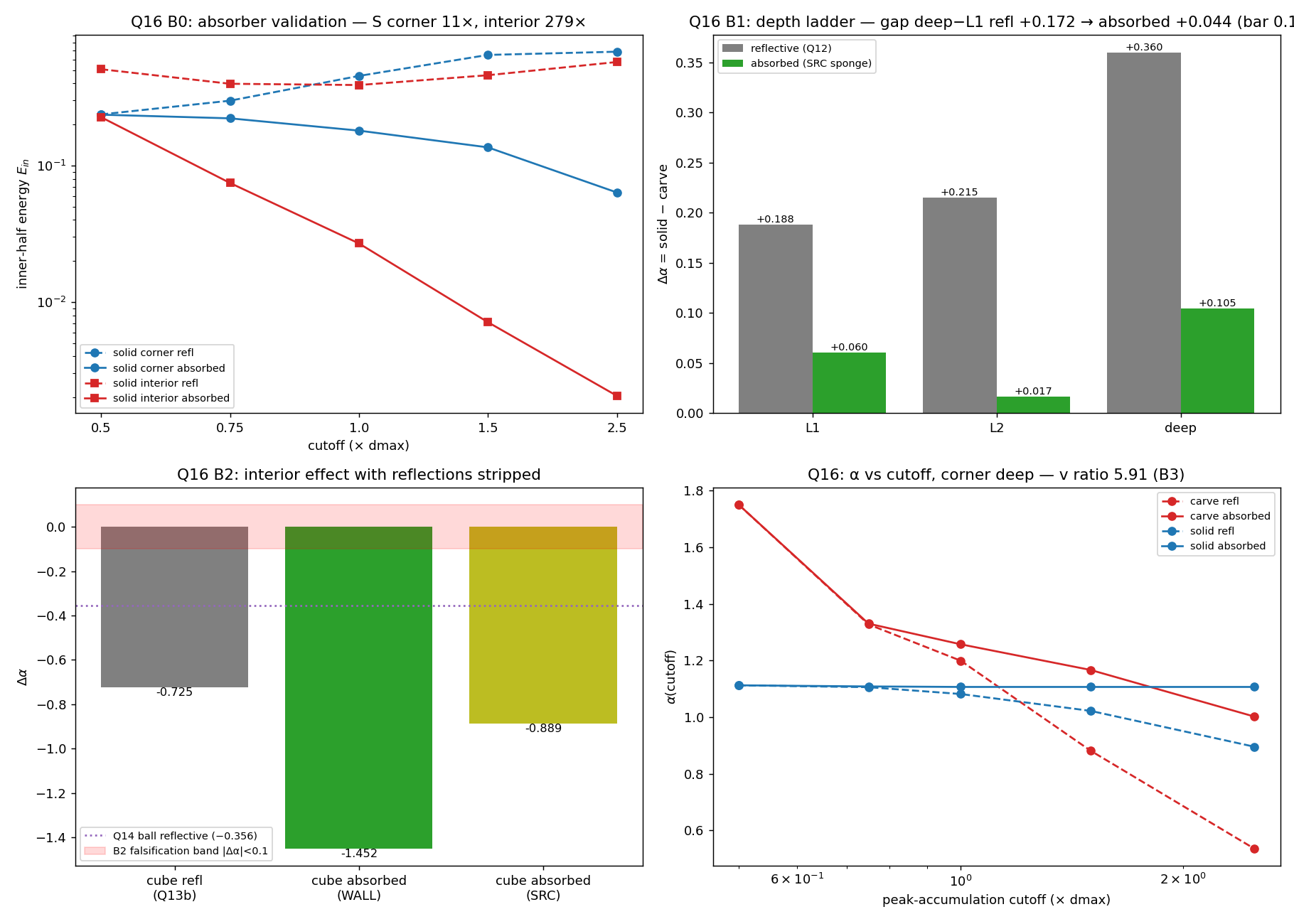
Open domain: which wave claims survive with reflections removed?
Absorbing boundaries plus a first-arrival cutoff ladder, re-measuring the three
load-bearing claims. B1 — the depth premium fails as registered
(+0.044 < 0.1); a labeled post-hoc convergence correction recovers ≥ +0.123 with the
monotone ordering broken — weakened, not hardened; roughly half to two-thirds of every
reflective Δα was differential reflection inflation. B2 — the interior penalty is
confirmed hardened: −0.725 → −0.889 (source-distance sponge) / −1.452 (wall
sponge) with exterior reflections killed. B3 — cone slowdown confirmed,
stronger than reported (corner ratio 5.91, interior 2.57). The "any holes help" baseline
collapses to +0.02…+0.06 — mostly a closed-box effect. Zero causality violations in all
20 runs.
The B1 rescue rests on a longer (5·dmax) run of the carve arms only,
registered after the full run and before the long run; even +0.123 is a lower bound — the
registered verdict stands as registered, the correction is labeled.
q16_open_domain.png — most of the loudness was the carve's own trapped energy coming back; the interior penalty grows.
Q17falsified · burial2026-08-11 · pre-registered
Closing Q8's escape hatches
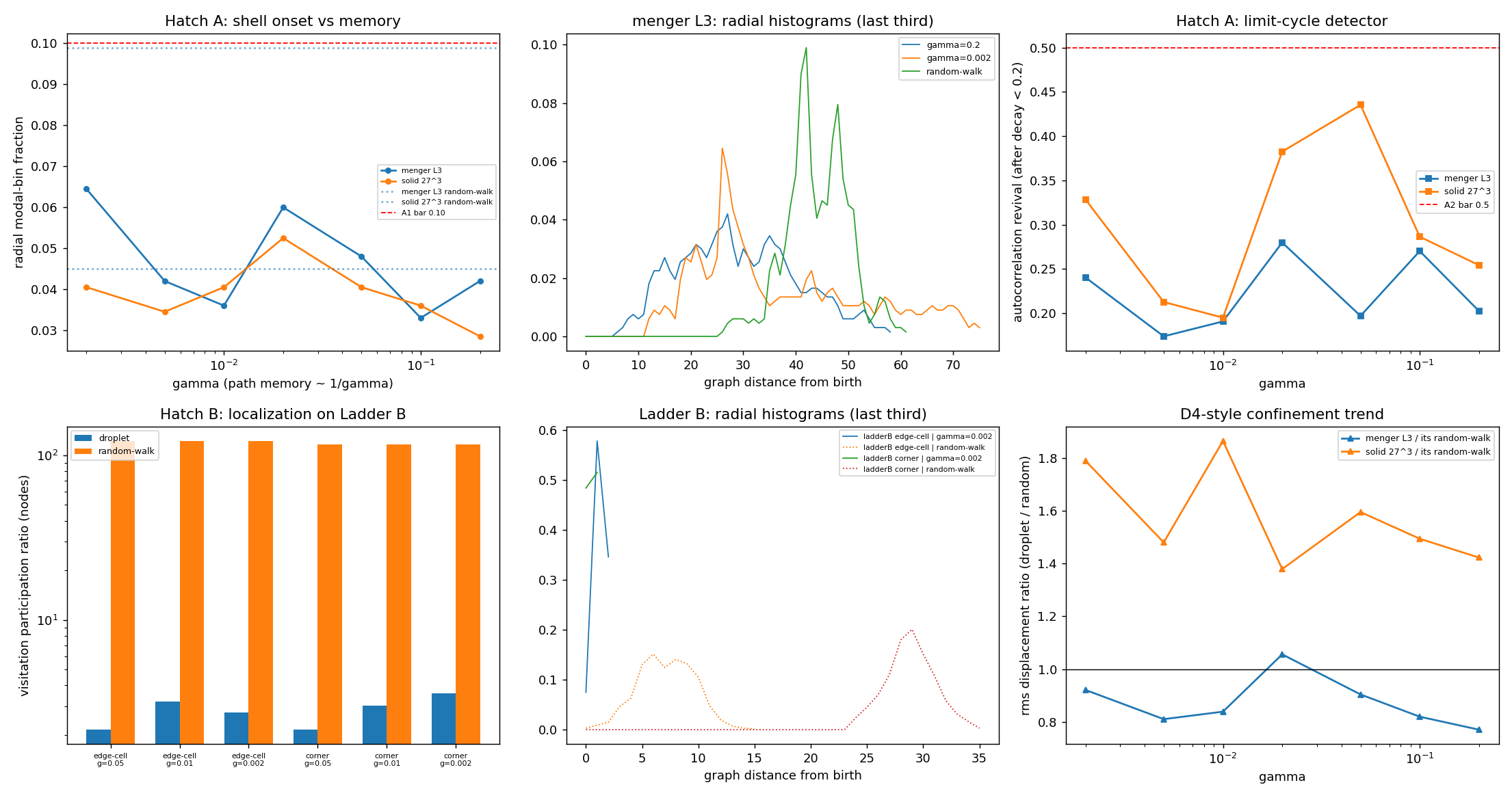
Hatch A closed: a two-decade fine memory scan (γ down to 0.002, memory
~250 splashes) finds no shell onset — max peak_frac 0.0645 vs the 0.10 bar, no limit
cycle anywhere (revivals 0.17–0.28 vs 0.5). Q8's one live thread (D4) also dies: the
confinement ratio wanders 0.77–1.06 with no trend — the earlier −28% was coarse-scan
noise. Hatch B closed: every Ladder B droplet run freezes (stuck_frac
0.59–0.74, participation ratio 0.018–0.031 of the random-walk control) — excluded by the
pre-registered moving-state bars, but a real substrate-specific secondary finding: the
49.5%-flat-band substrate parks the walker, it never orbits it. The minimal
pilot-wave-on-the-carve mechanism is closed at graph-wave realism.
The frozen corner-origin droplets ring in a tiny period-14 cycle
(autocorrelation revival 0.71/0.61 at lag 14) — excluded from all verdicts by the moving
requirement, reported for the record.
q17_hatches.png — two decades of memory, two substrates, no orbits.
T1 · T2 · T4 · T5registered · not in ledger
Handoff tasks without ledger entries
The handoff document that registered T3 and T6 also registered T1
(generalized Menger fractions — search d-dimensional removal rules against the cosmic
fractions), T2 (the log-ladder map — decade positions of fundamental
scales against k-fold log-partitions), T4 (CMB discrete scale invariance —
log-periodicity tests on public Planck maps), and T5 (the Dirac
square-law check). Their results are not recorded in the ledger this page is built from,
so no numbers are claimed for them here. Given the ledger's standing rule on
constant-matching (search-before-registration is dead; the measured null rate is ~5/14
hits at 0.5% tolerance), T1/T2/T5-style tasks are admissible only as pre-registered
single-rule tests.